
-
Research Services<a class="dhimg1" href="/shichangdetail1/9.html" target="_self" rel="nofollow"> <img src="https://omo-oss-image.thefastimg.com/portal-saas/pg2026042316544414203/cms/image/8926ff01-64bc-4928-a995-396bdb9d8102.jpg" alt="Aniphe BioLab"> </a> <a class="dhimg2" href="/shichangdetail/8.html" target="_self" rel="nofollow"> <img src="https://omo-oss-image.thefastimg.com/portal-saas/pg2026042316544414203/cms/image/26342b34-4f1e-4d28-9166-7b685e6d70c3.jpg" alt="Aniphe BioLab"> </a>


-
Preclinical CRO<a class="dhimg1" href="/shichangdetail/6.html" target="_self" rel="nofollow"> <img src="https://omo-oss-image.thefastimg.com/portal-saas/pg2026042316544414203/cms/image/cc43bac1-07d9-4340-9677-fbe01c51330a.jpg" alt="Aniphe BioLab"> </a> <a class="dhimg2" href="/shichangdetail/10.html" rel="nofollow" target="_self"> <img src="https://omo-oss-image.thefastimg.com/portal-saas/pg2026042316544414203/cms/image/f1d8f739-0d36-4cb8-adeb-26de791d909c.jpg" alt="Aniphe BioLab"> </a>


-
-
-
-


Latest News
Focusing on cutting-edge technologies and research advancements,
sharing Aniphe BioLab’s achievements in scientific innovation,
Professional insights
and practical experience in the fields of laboratory animals and preclinical research.
Publish an article
Disease Model | Construction of an Alcohol-Induced Liver Injury (ALD) model, with comprehensive assessments including histopathology, biochemical analyses, Oil Red O staining, and H&E staining!
Alcoholic liver disease (ALD) It refers to liver metabolic damage caused by alcohol consumption. In the early stages, it typically manifests as alcoholic fatty liver; if left untreated, it may progress to severe conditions such as alcoholic hepatitis, hepatic fibrosis, cirrhosis, and even hepatocellular carcinoma.
Animal experimentation is an essential approach for investigating disease therapies, and stable, reliable, and reproducible animal models are indispensable prerequisites for conducting such studies. Alcohol‑induced liver injury models can be classified into acute liver injury models and chronic alcohol‑induced liver injury models.
| Laboratory animals: Rat or mouse
| Experimental Protocol:
Healthy male Wistar or SD rats were used. They were administered 56° baijiu by gavage at a dose of 7 mL/kg, twice daily—once in the morning and once in the evening—for one week. Throughout the experiment, the animals had free access to water and were fed a standard diet.
Advantages: The model mimics the human pattern of alcohol consumption, exhibits a low mortality rate, and can be established in a short time.
Disadvantages: The absorption rate cannot be estimated; it only causes a mild increase in serum ALT and AST levels.
Applicable to: Study on the mechanisms of acute onset in alcoholic liver injury.
| Laboratory animals: 10–12-week-old male C57 mice
| Experimental Protocol:
① Prepare the feed in liquid form and add alcohol, gradually increasing the alcohol concentration over one week, e.g., 1% → 2% → 3% → 4%.
② After one week, the alcohol concentration was increased to 5%; following 14 days of chronic alcohol consumption, a high‑concentration acute gavage (at a dose of 5 g/kg body weight) was administered on the final day of model induction, which can induce alcoholic liver injury in mice.
| Experimental Evaluation System:
| Experimental Results:
① Pathological tissue:

Image source: Aniphe BioLab
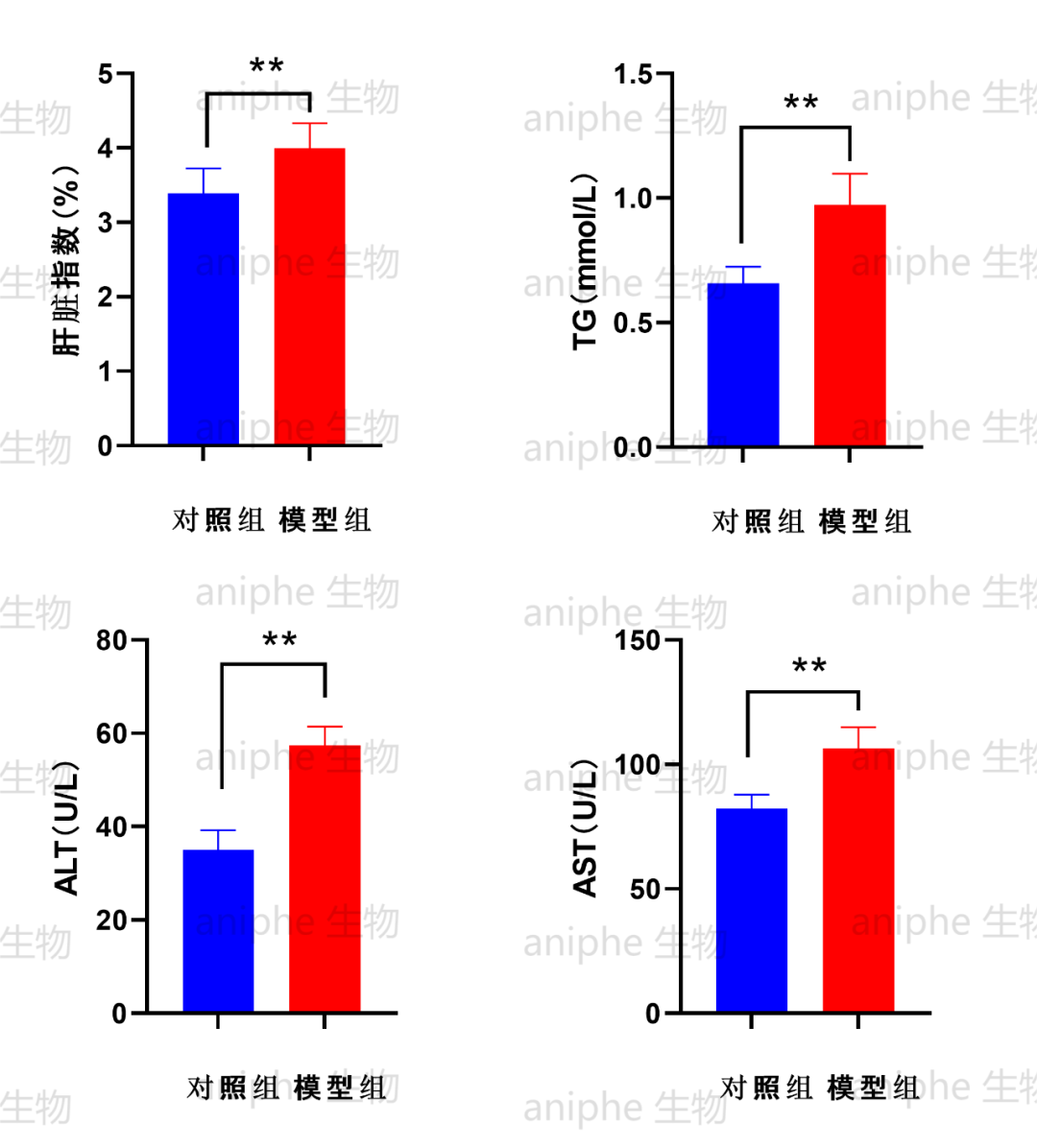
② Liver coefficient and biochemical results:
In the model group, the liver coefficient was significantly increased, and the levels of TG, ALT, and AST were markedly elevated.
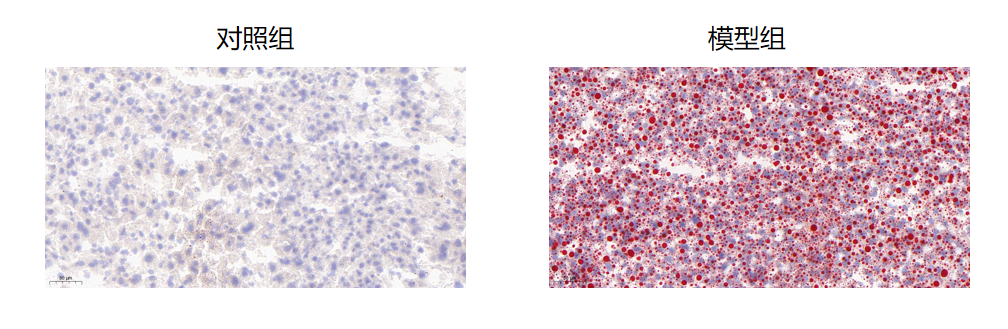
③ Oil Red O staining results
In the model group, red-stained large lipid droplets were observed within hepatocytes, with a widespread distribution, and marked hepatic steatosis was evident.
④ HE staining results
In the model group, mice exhibited marked hepatocyte enlargement and disorganized architecture, along with the presence of irregular lipid vacuoles.
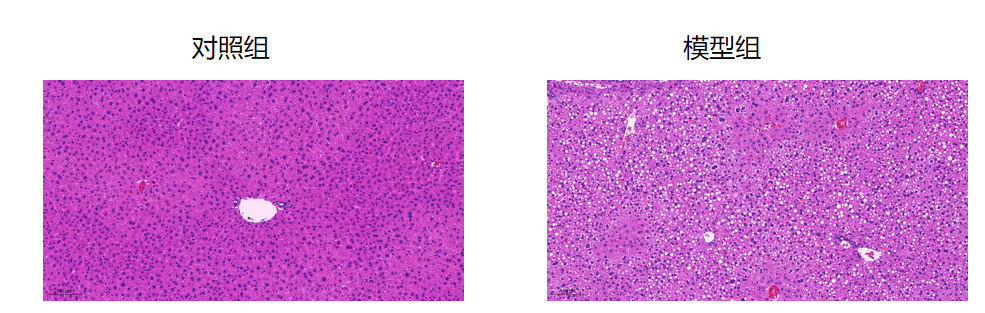
This indicates that the alcoholic liver injury model has been successfully established.
|Precautions
In this experiment, the feed was formulated into a liquid state; it is optimal to replace the feed daily. Any excess formulation should be stored at 4°C in a sealed container for no more than one week.
Alcohol affects food intake; if animals exhibit poor health or mortality, the concentration should be maintained at no more than 4%.
If the goal is to exacerbate fatty liver and hepatic injury, a high-concentration alcohol bolus gavage may be administered on the final day of model induction.
This modeling method is simple and highly reproducible, enabling the simulation of the pathogenesis of human alcoholic hepatitis. It is characterized by a marked elevation in serum ALT levels, pronounced hepatic steatosis and inflammation, prominent neutrophil infiltration in the liver, and elevated blood alcohol concentrations, thereby providing an ideal experimental paradigm for investigating the underlying mechanisms of alcoholic liver disease and evaluating the hepatoprotective effects of therapeutic agents.
With the steady improvement in living standards, the incidence of alcoholic liver disease has been increasing year by year. Selecting an appropriate model of alcoholic liver injury (ALD) that aligns with the research objectives is crucial for elucidating its pathogenic mechanisms and advancing clinical diagnosis and treatment. Aniphe BioLab offers multiple approaches to establish ALD models and provides pharmacological and efficacy evaluation services tailored to related disease models. We welcome all clients to contact us for more information!
PREVIOUS:
Aniphe BioLab Inc.
Address:
Runcheng, No. 8 Longtai Road, Jiangbei New Area, Nanjing City, Jiangsu Province
Building 8, Science Park
Postal Code: 210007
Phone:025-8520 8061
Email:info@aniphebio.com(Consultation)
Email:order@aniphebio.com(Order)


WeChat Official Account
Video Account
 Su Public Security Bureau Internet Information Service Filing No. 32010402001421