
-
Research Services<a class="dhimg1" href="/shichangdetail1/9.html" target="_self" rel="nofollow"> <img src="https://omo-oss-image.thefastimg.com/portal-saas/pg2026042316544414203/cms/image/8926ff01-64bc-4928-a995-396bdb9d8102.jpg" alt="Aniphe BioLab"> </a> <a class="dhimg2" href="/shichangdetail/8.html" target="_self" rel="nofollow"> <img src="https://omo-oss-image.thefastimg.com/portal-saas/pg2026042316544414203/cms/image/26342b34-4f1e-4d28-9166-7b685e6d70c3.jpg" alt="Aniphe BioLab"> </a>


-
Preclinical CRO<a class="dhimg1" href="/shichangdetail/6.html" target="_self" rel="nofollow"> <img src="https://omo-oss-image.thefastimg.com/portal-saas/pg2026042316544414203/cms/image/cc43bac1-07d9-4340-9677-fbe01c51330a.jpg" alt="Aniphe BioLab"> </a> <a class="dhimg2" href="/shichangdetail/10.html" rel="nofollow" target="_self"> <img src="https://omo-oss-image.thefastimg.com/portal-saas/pg2026042316544414203/cms/image/f1d8f739-0d36-4cb8-adeb-26de791d909c.jpg" alt="Aniphe BioLab"> </a>


-
-
-
-


Latest News
Focusing on cutting-edge technologies and research advancements,
sharing Aniphe BioLab’s achievements in scientific innovation,
Professional insights
and practical experience in the fields of laboratory animals and preclinical research.
Publish an article
Key Insights | Five FAD transgenic mouse models—everything you want to know about their brain volume, amyloid‑β deposition, glial activation, and other phenotypic features is right here!
Introduction: The 5×FAD transgenic mouse, a classic animal model of Alzheimer’s disease, is widely used in studies of AD pathogenesis and in the development of novel AD therapeutics. This review summarizes key phenotypic features of these mice—such as brain volume, amyloid‑β deposition, and glial activation—and provides a comprehensive overview for reference.
—————————————————
The pathogenic mechanisms of Alzheimer’s disease (AD) encompass amyloid‑β deposition, abnormal phosphorylation of tau protein, neuroinflammation, oxidative stress, mitochondrial dysfunction, calcium homeostasis disruption, and glial cell dysfunction. However, owing to the still‑unclear etiology and the lack of systematic, comprehensive pathological and physiological studies, no ideal therapeutic agents have yet been developed. Consequently, there is an urgent need for stable, reliable animal models to facilitate research into AD therapies.
Today, we introduce another widely used animal model for Alzheimer’s disease: the 5×FAD mouse.
5×FAD transgenic mice
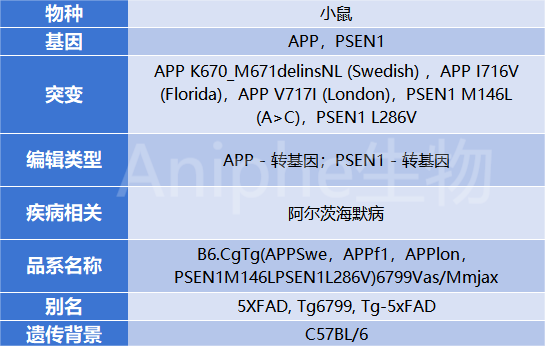
Image source: Ailinfei
5xFAD mice express human APP and PSEN1 transgenes, carrying five AD‑related mutations: the Swedish (K670N/M671L), Florida (I716V), and London (V717I) familial Alzheimer’s disease (FAD) mutations in APP, as well as two FAD mutations—M146L and L286V—in the human PS1 gene, which overexpresses the 695‑amino‑acid isoform of the amyloid‑β (A4) precursor protein (APP).

Image source: [2]
The expression of both M146L and L286V is regulated by a mouse neuron-specific element—the Thy1-driven promoter, which drives overexpression in the brain.
At 1.5 months of age, 5×FAD mice already exhibit abundant β‑amyloid (Aβ) in the brain, and by 2 months of age, neuritic plaques (NP) begin to appear. The pathological phenotypes of 5×FAD mice include amyloid plaque deposition, neuronal loss, glial cell activation, and cognitive impairment.

These 5XFAD transgenic mice rapidly recapitulate the key hallmarks of amyloid pathology in Alzheimer’s disease and may serve as a valuable model for Aβ‑42–induced neurodegeneration and amyloid plaque formation within neurons.
Brain volume increases with age.

Sources of brain volume across different sexes and age groups [3]
The brain volume of 5xFAD mice increases with age, and both male and female brains exhibit significant genotype‑dependent differences by the age of eight months in females.
Amyloid deposition and glial proliferation
In 5xFAD mice, amyloid deposition begins in the deep and lower cortical layers at 2 months of age and, with advancing age, spreads to other brain regions. In the B6SJL hybrid background, the amyloid phenotype in 5xFAD mice is more stable.

Amyloid deposition and glial activation in the 5XFAD model; image source: [2]
Astrocytic and microglial proliferation begin to emerge around two months, progressing in parallel with amyloid plaque deposition.

Rapid cerebral amyloid deposition and glial activation in 5XFAD Tg6799 mice at 2, 4, 6, and 9 months of age; image source: [2].
Neuronal loss
An upward trend was observed in 5xFAD mice at 3 months of age, with neuronal loss evident in the cortical layer V and lower layers.

Tg6799: Images of loss of cortical layer V and underlying neurons are sourced from [2].
Synaptic loss
The synaptic markers synaptophysin, syntaxin, and PSD-95 exhibit decreased expression with advancing age in mice.

Image source: [3]
Changes in LTP/LTD
Basal synaptic transmission and LTP in the CA1 region of the hippocampus begin to deteriorate between 4 and 6 months, but paired-pulse facilitation remains normal at least until 6 months.
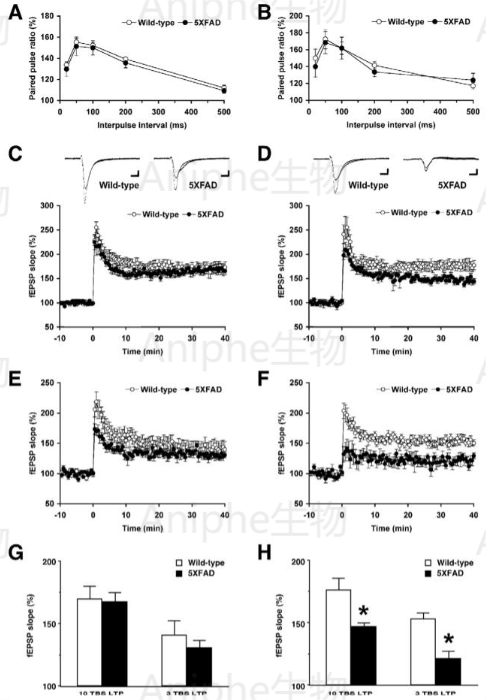
Age-dependent impairment of LTP in hippocampal slices from 5XFAD mice, but not paired-pulse facilitation; image reproduced from [4].
Deficits in basal synaptic transmission were also observed in layer V of the somatosensory cortex of 6-month-old 5xFAD mice. At approximately one month and between 11 and 15 months, there were no differences between transgenic and wild-type mice in the amplitude or frequency of spontaneous excitatory postsynaptic currents in the radiatum layer of the hippocampus.
Mouse behavioral phenotype
At 4–5 months of age, 5XFAD mice exhibit impaired learning and memory, as evidenced by reduced spontaneous alternation performance in the Y-maze.
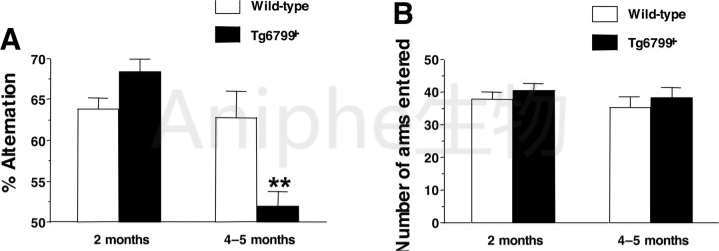
Memory deficits in 5XFAD mice increase with age; image source: [2].
In conditioned fear memory experiments involving cues and contextual stimuli, a decline in learning and memory performance was observed. Similarly, deficits in learning and memory were evident in the water maze task and other hippocampus‑dependent memory tasks.
Application areas
Research on the pathogenesis of AD: By investigating the pathological features and behavioral alterations in 5xFAD mice, it is possible to gain deeper insights into the pathogenic mechanisms of Alzheimer’s disease, particularly the pathological processes associated with β‑amyloid deposition and synaptic dysfunction.
Drug screening and therapeutic evaluation: 5xFAD mice can be used to evaluate the efficacy of potential therapies and drugs for Alzheimer’s disease, including anti-amyloid agents and neuroprotective compounds.
Research on Genetic and Environmental Factors: By conducting comparative studies with other transgenic mouse models, it is possible to elucidate the interactions between genetic and environmental factors in the pathogenesis of Alzheimer’s disease.
————————
Jiangsu Aniphe BioLab Inc., established in 2018, is committed to becoming an internationally renowned preclinical pharmacodynamic evaluation company in the new era of biopharmaceutical development. Aniphe BioLab has built a comprehensive SPF‑grade laboratory animal facility that integrates animal breeding and husbandry, disease model development, and in vivo experimentation, covering areas such as oncology, neuroscience, and metabolism. The center houses over 5,000 cages for mice and rats and, in addition to supporting animal research needs, is equipped with state‑of‑the‑art platforms for cell, molecular, and protein analysis, providing a more holistic suite of services to meet diverse scientific research requirements. By fostering collaboration among industry, academia, and research institutions, the company drives innovation and advances drug discovery. We warmly welcome clients to contact us for inquiries.
References:
[1] Liu Yiduan, Liu Yixiao, Han Xinyuan, et al. Advances in the application of 5×FAD transgenic mice in Alzheimer’s disease research [J/OL]. Chinese Journal of Laboratory Animal Science, 1–16 [2024-01-18] http://kns.cnki.net/kcms/detail/11.2986.Q.20231206.1646.002.html.
[2] Oakley H, Cole SL, Logan S, Maus E, Shao P, Craft J, Guillozet-Bongaarts A, Ohno M, Disterhoft J, Van Eldik L, Berry R, Vassar R. Intraneuronal beta-amyloid aggregates, neurodegeneration, and neuron loss in transgenic mice with five familial Alzheimer's disease mutations: potential factors in amyloid plaque formation. J Neurosci. 2006 Oct 4;26(40):10129-40. doi: 10.1523/JNEUROSCI.1202-06.2006. PMID: 17021169; PMCID: PMC6674618.
[3] Boza-Serrano, A., Yang, Y., Paulus, A. et al. Innate immune alterations are elicited in microglial cells before plaque deposition in the Alzheimer’s disease mouse model 5xFAD. Sci Rep 8, 1550 (2018). https://doi.org/10.1038/s41598-018-19699-y
[4] Kimura R, Ohno M. Impairments in remote memory stabilization precede hippocampal synaptic and cognitive failures in 5XFAD Alzheimer mouse model. Neurobiol Dis. 2009 Feb;33(2):229-35. doi: 10.1016/j.nbd.2008.10.006. Epub 2008 Nov 5. PMID: 19026746; PMCID: PMC2741400.
【5】034848 - 5xFAD , 5x-FAD, Tg6799 Strain Details (jax.org)
Aniphe BioLab Inc.
Address:
Runcheng, No. 8 Longtai Road, Jiangbei New Area, Nanjing City, Jiangsu Province
Building 8, Science Park
Postal Code: 210007
Phone:025-8520 8061
Email:info@aniphebio.com(Consultation)
Email:order@aniphebio.com(Order)


WeChat Official Account
Video Account
 Su Public Security Bureau Internet Information Service Filing No. 32010402001421