
-
Research Services<a class="dhimg1" href="/shichangdetail1/9.html" target="_self" rel="nofollow"> <img src="https://omo-oss-image.thefastimg.com/portal-saas/pg2026042316544414203/cms/image/8926ff01-64bc-4928-a995-396bdb9d8102.jpg" alt="Aniphe BioLab"> </a> <a class="dhimg2" href="/shichangdetail/8.html" target="_self" rel="nofollow"> <img src="https://omo-oss-image.thefastimg.com/portal-saas/pg2026042316544414203/cms/image/26342b34-4f1e-4d28-9166-7b685e6d70c3.jpg" alt="Aniphe BioLab"> </a>


-
Preclinical CRO<a class="dhimg1" href="/shichangdetail/6.html" target="_self" rel="nofollow"> <img src="https://omo-oss-image.thefastimg.com/portal-saas/pg2026042316544414203/cms/image/cc43bac1-07d9-4340-9677-fbe01c51330a.jpg" alt="Aniphe BioLab"> </a> <a class="dhimg2" href="/shichangdetail/10.html" rel="nofollow" target="_self"> <img src="https://omo-oss-image.thefastimg.com/portal-saas/pg2026042316544414203/cms/image/f1d8f739-0d36-4cb8-adeb-26de791d909c.jpg" alt="Aniphe BioLab"> </a>


-
-
-
-


Latest News
Focusing on cutting-edge technologies and research advancements,
sharing Aniphe BioLab’s achievements in scientific innovation,
Professional insights
and practical experience in the fields of laboratory animals and preclinical research.
Publish an article
Disease model | Methods for establishing a chronic, refractory psoriasis model, including imiquimod‑induced cases, topical application dosages, and HE analysis...
Psoriasis is a common dermatological condition characterized by erythematous plaques covered with silvery scales on the scalp, trunk, and extremities. It is recurrent and often refractory, significantly impacting patients’ physical and psychological well-being. The pathogenesis of psoriasis is complex, resulting from the interplay of genetic factors, immune dysregulation, and environmental influences. Establishing an optimal animal model of psoriasis would greatly facilitate elucidation of its genetic underpinnings, pathogenic mechanisms, and the development of novel therapeutics.
Common animal models of psoriasis
Psoriasis animal models can be classified into five categories, namely: Drug‑induced models, genetically engineered models, cytokine‑based models, xenograft models, and spontaneous mutation models.
| Drug-induced model
A drug‑induced model refers to a method in which topical application of a drug or feeding animals a diet deficient in essential fatty acids is used to elicit psoriasis‑like skin lesions and inflammatory responses on the animal’s skin. At present, the most widely employed model is the imiquimod‑induced mouse model.
Case Study: Imiquimod-Induced Model by Aniphe BioLab :
| Laboratory Animals
6-week-old C57 male.
| Modeling Method
01
Shave a 2 cm × 3 cm area on the mouse’s back, then apply depilatory cream to the area to remove all hair.
02
Using a 1 mL syringe, draw up imiquimod ointment, expel any air from the syringe barrel, and inject 0.06 mL of the ointment into the depilated area, then spread it evenly.
03
After application, the mice should not be placed in their cages immediately; allow 5–10 minutes for partial absorption of the cream before returning them to their cages.
04
Apply once daily for 5 to 10 consecutive days, and assess the skin daily using the PASI score.
The scoring criteria are as follows:
Daily observation of the skin condition in the area treated with the medication; based on the PASI, the severity of back skin lesions (thickening, scaling, erythema) is scored on a scale from 0 to 4.
Based on the PASI, the severity of skin inflammation is assessed once daily, including measurements of skin erythema, scaling, and induration, with scores ranging from 0 to 4: 0 = none; 1 = mild; 2 = moderate; 3 = marked; 4 = very marked.
| Experimental Evaluation System
① Skin lesion images :

Image source: Aniphe BioLab
② HE results show:
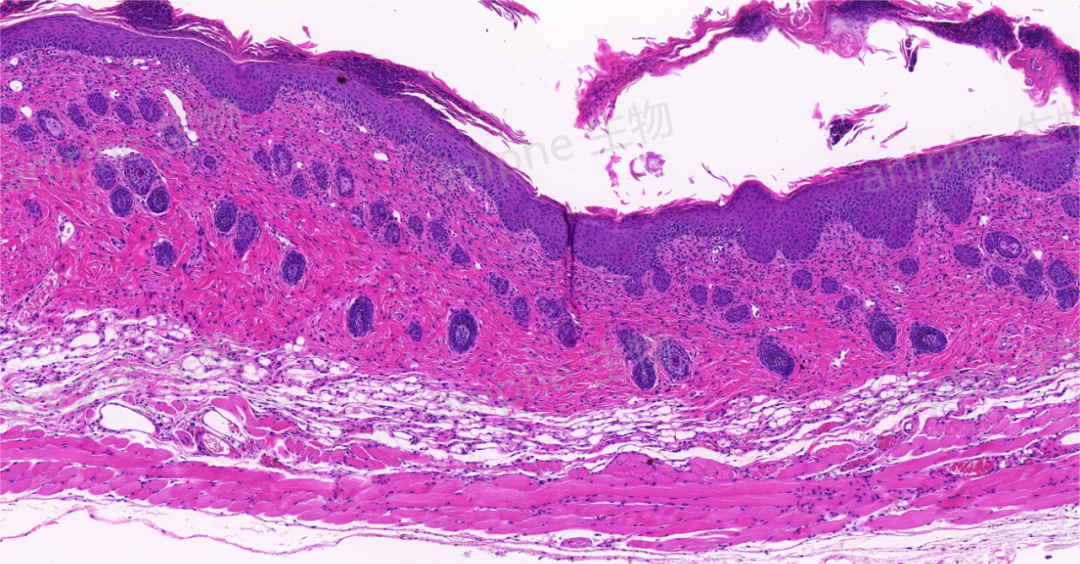
The results; image source: Aniphe BioLab.
Compared with the control group, the skin of mice treated with imq exhibited typical psoriasis‑like features, including acanthosis, inflammatory cell infiltration, and dermal vascular alterations.
| Model Features:
It is low-cost, highly operable, exhibits excellent reproducibility, requires a short modeling time, and produces skin lesions that closely resemble those of the target condition.
| Other induction methods
① Cytokine model
Currently, injecting a series of cytokines—including IL‑23, IL‑12, IL‑36, IL‑22, and IL‑17C—into the skin of mice, in combination with oncostatin M (Oncostatin‑M) and IL‑33, has been employed to induce psoriasis‑like skin inflammation. Among the various cytokine‑injection mouse models, IL‑23 injection is the most commonly used approach; this cytokine has been administered in over 50 distinct genetically engineered mouse models to establish disease‑relevant phenotypes.
The cytokine‑induced psoriasis model is easy to establish, can be combined with various other genetically engineered mouse models, and does not require extensive time or resources for modeling; moreover, it is relatively inexpensive. However, the psoriasis‑like skin lesions induced by this model represent an acute inflammatory response that, upon cessation of injections, gradually resolve on their own.
② Xenotransplantation model
Currently, the primary recipient strains for this type of model are nude mice, severe combined immunodeficiency (SCID) mice, and AGR129 mice. Among these, nude mice were the first to be used for such models; SCID mice are the most widely employed; and AGR129 mice are xenograft models in which functional T cells, B cells, and NK cells are absent due to the knockout of the RAG gene.
Because it requires obtaining substantial untreated lesional or non-lesional skin tissue and peripheral blood from psoriasis patients, and necessitates rapid tissue collection and transplantation to prevent graft ischemia and rejection, this model has not been widely adopted.
③ Spontaneous Mutation Model
Prominent examples of spontaneously mutant mouse models include the Asebia mouse, the scaly skin mouse (Fsn mouse), and the chronic proliferative dermatitis mouse. These spontaneous mutant mice all exhibit histopathological features characteristic of psoriasis; however, T cells and neutrophils are rarely observed in their tissue sections, and they respond poorly to conventional therapies for psoriasis. As methods for generating psoriasis animal models have advanced, the use of these spontaneous mutant strains has gradually declined, and they have increasingly served as genetic backgrounds for other psoriasis‑related animal models.
④ Genetic engineering model
Genetically engineered mouse models account for the largest proportion among all psoriasis mouse models; currently reported genetic mouse models of psoriasis primarily include transgenic mouse models and gene-knockout mouse models.
Gene-knockout mice: These can be further classified into complete gene knockout and partial gene knockout, whereby specific genes in mice are either completely or partially knocked out to induce psoriasis‑like skin lesions.
Transgenic mouse model: These models are generated by using transgenic techniques to overexpress specific genes in mice, thereby inducing psoriasis‑like skin lesions. In most cases, this is achieved by driving the expression of target genes under the control of epidermal basal layer promoters, such as keratin 5 (K5), keratin 14 (K14), keratin 10 (K10), or involucrin, which in turn leads to the development of psoriasis‑like cutaneous manifestations.
Genetically engineered animal models, from a molecular and cellular perspective, achieve psoriasis‑like skin pathology by manipulating specific individual genes, thereby exhibiting strong specificity. They enable the elucidation of the roles of particular genes in the pathogenesis of psoriasis and are well suited for examining the expression, function, and effects of single genes. However, these models involve complex procedures, require substantial time, and are costly, and they cannot fully replicate the intricate processes underlying human psoriasis that arise from the combined actions of multiple genes. Consequently, there remains considerable room for further research in developing transgenic animal models of psoriasis.
Summary
It is believed that, as research into the pathogenesis of psoriasis deepens and more disease‑related genes are identified and characterized, an increasing number of animal models—more precise in reflecting the disease’s mechanisms and clinical features—will emerge, thereby providing more valuable insights for elucidating its pathogenic pathways and developing novel therapeutic strategies.
Aniphe BioLab offers a variety of approaches for establishing psoriasis animal models and provides pharmacological and efficacy evaluation services tailored to these disease models. We welcome all clients to contact us for more information!
PREVIOUS:
Aniphe BioLab Inc.
Address:
Runcheng, No. 8 Longtai Road, Jiangbei New Area, Nanjing City, Jiangsu Province
Building 8, Science Park
Postal Code: 210007
Phone:025-8520 8061
Email:info@aniphebio.com(Consultation)
Email:order@aniphebio.com(Order)


WeChat Official Account
Video Account
 Su Public Security Bureau Internet Information Service Filing No. 32010402001421